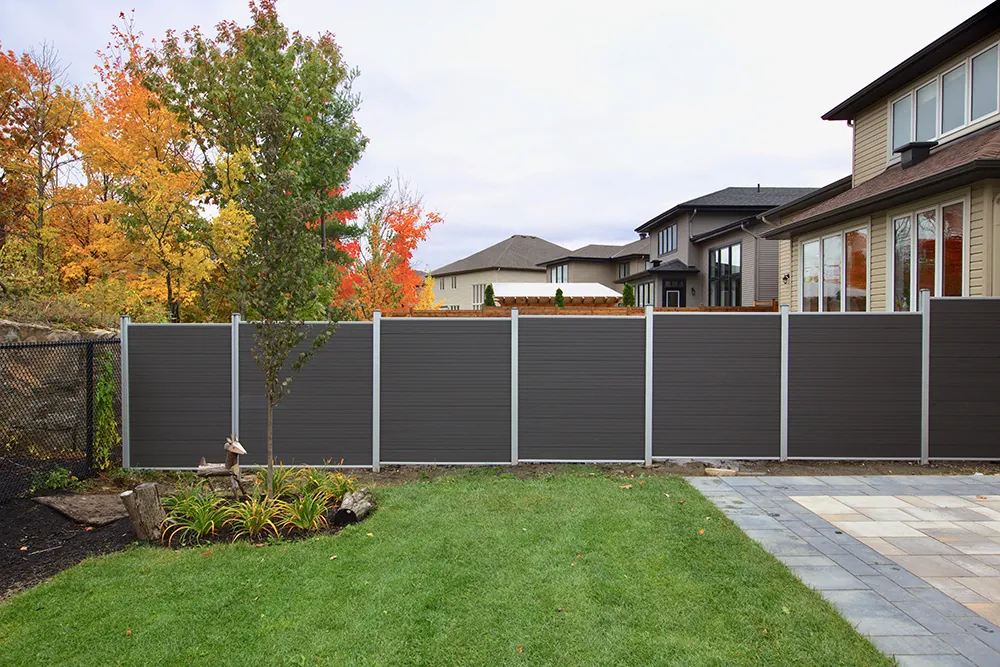
Honest Comparison
WPC vs Colorbond fencing
Both are low-maintenance boundary options built to last. The short version: Colorbond wins on lowest upfront price, while WPC wins on looks, summer heat, privacy and resale. Here's the full side-by-side so you can pick with your eyes open.
The Honest Verdict
Both are good fences. They just win on different things
If you've narrowed your boundary down to composite WPC or Colorbond steel, you've already ruled out the high-maintenance options. Neither needs staining, neither rots, and both will comfortably outlast a timber paling fence. So this isn't a case of one being "bad". It's about which trade-offs suit your home.
Colorbond's advantage is the day-one price. It's typically the cheapest of the two per linear metre, it goes up fast, and it's a proven Australian product that suburbs are full of. If your only goal is a solid boundary at the lowest upfront cost, it's hard to beat.
WPC wins almost everywhere else that owners actually notice day to day. It looks like real timber rather than painted steel, it stays cool enough to touch on a 45°C afternoon, its dense board dampens road and pool noise instead of ringing, it never dents or rusts, and it lifts resale value where a steel fence rarely does. You pay a little more upfront and get those benefits for the full 15-year warranty and beyond.
Side By Side
WPC composite vs Colorbond steel.
Figures below are AU 2026 estimates for a 1.8m × 30 lineal-metre suburban Sydney boundary, supplied & installed. Timber is shown as a reference third column. Treat them as a starting point, your written quote models your actual job.
| Criteria | Recommended Fencly Co-Ex WPC Capped ASA/PE composite | Colorbond Steel Standard sheet | Hardwood Timber Treated pine / merbau |
|---|---|---|---|
| Upfront cost (per lm) | $250–$280Mid-range | $220–$280Lowest upfront | $180–$275Cheap day one |
| Maintenance over 25 years | $0Annual hose-down | + $4,200Repaint x2 + rust repair | + $9,750Stain every 2 yrs |
| Surface heat (45°C day) | ~ 52 °CSafe to touch | ~ 78 °CCan burn skin | ~ 49 °C |
| Privacy & acoustics | High · dense board absorbs noise | Solid screen but steel rings | Medium · gaps open with age |
| Dent & rust resistance | No dents · never rusts | Dents on impact · rusts at base | No rust · rots & warps |
| Manufacturer warranty | 15 years | 10 years (paint) | None |
| Look at year 25 | Same as day 1 | Faded, dented, rust spots | Greyed, splintered, sagging |
| Resale & curb appeal | +5–8% home value | Neutral / functional | Neutral, then a liability |
Get the figures for your own boundary.
Supply Only · Trade Welcome→Figures are AU 2026 estimates for a 1.8m × 30 lineal-metre suburban Sydney boundary, supply only, installed by a third party. Surface-heat figures are indicative for dark colours on a 45°C ambient day. Maintenance assumes industry-standard upkeep schedules. Your written quote will reflect site conditions, access & finish.
Playing Fair
When Colorbond still makes sense
We supply WPC, so of course we're fond of it, but we'd rather you chose the right fence than the one we happen to sell. There are real situations where Colorbond is the smarter call:
- Lowest upfront budget rules. If the day-one number has to be as low as possible, a rental, a flip, or a long back run nobody sees, Colorbond's cheaper per-metre price is a legitimate win.
- Very long, low-visibility runs. For a rear boundary against bushland or a paddock, the look and resale lift of WPC matter less, so paying the premium is harder to justify.
- Bushfire-attack (BAL) requirements. Non-combustible steel can be the simpler path for high-BAL zones. WPC is fire-rated but always confirm your BAL and council requirements first.
- You genuinely prefer the steel look. Some homes, especially modern rendered facades - suit a crisp monument-grey steel line, and that's a valid aesthetic choice.
Outside those cases, most owners who compare the two side by side choose WPC for the timber look that never needs painting, the cooler summer surface and the quieter backyard. If you want the pricing detail, our WPC fencing cost guide breaks down exactly what drives the per-metre figure, and the WPC vs timber comparison covers the other popular option.
Comparison FAQ
WPC vs Colorbond questions.
Is WPC hotter than Colorbond?
No, the opposite. On a 45°C day, dark Colorbond steel can hit around 78°C while the same-colour co-extruded WPC board sits near 52°C. Thin steel conducts and radiates heat; the dense composite doesn't. Around pools, play areas and pets, that's a real safety and comfort win.
Is WPC more private than Colorbond?
For line-of-sight, both are solid gap-free screens. For sound, WPC wins: our 20mm dense board absorbs noise, while thin Colorbond rings and transmits it. Next to a busy road or a noisy neighbour, WPC gives a noticeably quieter, more private yard.
Which lasts longer, WPC or Colorbond?
Both are long-life. Colorbond can dent, fade and rust at the base over time; capped WPC is sealed on all four faces and holds its colour for the full 15-year warranty. At year 25 WPC typically looks like day 1, while Colorbond shows fading, dents and rust spots. See our warranty →
Is WPC or Colorbond cheaper?
Colorbond is usually cheapest on day one. But it needs repainting and rust repair, while WPC needs only a hose-down, so 25-year ownership lands close together. Lowest upfront? Colorbond. Best looks, heat and resale? WPC. See the full cost breakdown →
Weighing it up for your boundary? Send us an enquiry or call 0421 201 613.
Supply Only · Trade Welcome
See WPC against your home.
We bring colour samples to site so you can compare the WPC finish against your facade before deciding, a fixed-price quote inclusive of GST, usually within 24 hours. Serving Sydney and surrounds, with pro installation.